Easter 3A – Earth Sunday
Luke 24:13-35
April 19, 2026
This morning’s Gospel reading was the Road to Emmaus story. Last Sunday was Doubting Thomas. Of course, the Sunday before that was the resurrection story. We follow a three-year lectionary, rotating through the various readings every three years, but the format of the Easter season readings stays fairly consistent. The first three Sundays of Easter are “appearance" stories, then Jesus the Good Shepherd, then three Sundays of preparing to spread the mission and message of the early church. This is the arc of the stories heard from Easter to Pentecost.
Today we are hearing the 3rd of the appearance stories, when Jesus is still physically appearing to people following his death and before his ascension. First Jesus appeared to Mary Magdalene at the tomb, then he appeared to Thomas, and now he appears to two of his disciples who are walking home from Jerusalem, rehashing the amazing things that have happened that weekend.
And with two of these appearance stories, I am puzzled. I wonder how Jesus’ disciples did not recognize him. How did his beloved Mary Magdalene not recognize him? Were his disciples just so consumed with grief that they didn’t even take a good look at who they were talking to? Was it fear of the unknown future? Did Jesus’ appearance so defy what they thought was possible that their brains just couldn’t process who this was? What was blocking them from seeing the truth of what was in front of them? Something about the way they were perceiving their current reality needed to change before they could recognize the resurrected Jesus.
But then, each time, something jolts them into recognition. Jesus simply says Mary’s name, and suddenly she knows him. On the other hand, he has a very lengthy chat with our traveling disciples today, including a whole review of the Hebrew scriptures’ prophecy regarding his ministry, but that’s not enough. It is not until the taking, blessing, breaking and giving of the bread…that most Jesus thing ever…that the disciples recognize him. In both stories, something intervenes to open hearts, minds and eyes to this reality.
So then I wondered, “what might it look like today if someone like Jesus, a truth teller of some sort, appeared to us…would we recognize them? Would we believe what they had to say?”
I was recently reminded of the story of Cassandra from Greek mythology. Cassandra was a priestess in the temple of Apollo, and Apollo had gifted her with the ability to speak true prophecy, so that everything she proclaimed came true. But then he got mad at her and placed a curse on her so that no one would believe her prophecies. So, what she foretold was always true, but no one ever believed her. How frustrating! Again, what would that look like today?
It turns out that our personal biases are very effective at hiding truth from us. For example, as the information we receive today, often through social media, becomes more and more siloed, more curated for what we like to hear, we mainly receive the news that aligns with what we already believe. Psychologists call that confirmation bias. If it becomes too difficult to wrap our heads around a situation, then we tend to just ignore it. That’s called complexity bias…we like things that are simple to understand. If everyone else in our tribe - whether it be our family, our church community, the political party we identify with - believes a certain way, then we tend to think that way, too, whether that group-think is entirely accurate or not. That is called community bias. It’s hard to stand against the tribe because belonging is so important to us. Brian McLaren has put together a little book that identifies 13 common biases that all of us fall victim to.
So, here’s my modern-day example for this Earth Sunday:
Our scientists have been warning for years that the Earth is warming and that it is caused by humans emitting carbon into the atmosphere through the burning of fossil fuels. They have provided mounds of data and analyses and graphs to explain it all. But it’s complex and it doesn’t always track with what we have always believed to be true. Many in our community aren’t buying it, and we wonder why should we? So, we have discounted the scientists’ warnings, even as their forecasts have proven accurate. We haven’t trusted the scientists enough to change our ways to save our planet…and ourselves…from the effects of global warming. And we have generally taken a pass on exploring the questions:
“What is my part to play in this disaster?”
“What gifts do I bring to this work”?
We are like Doubting Thomas, but in our case, we can’t put our hands out and touch the wounds of the Earth, and in many ways it isn’t yet affecting us personally. So we dismiss these scientific Cassandras and go about our business as usual.
Using this season’s terminology, the Earth is still being crucified. It has been Good Friday for the planet since the Industrial Revolution, and the prophets have been shouting about that for at least the past 50 years. In his book Practice Resurrection, Eugene Peterson says that resurrection is God’s project, but we are included in every aspect of God’s activity. We are not running the show, but we are in it to do our part, the part we were given at birth, to make resurrection happen. But to do that, our eyes must be opened to receive; we must become aware of our biases and be open to the truth…and claim the gifts that will allow us to do our parts.
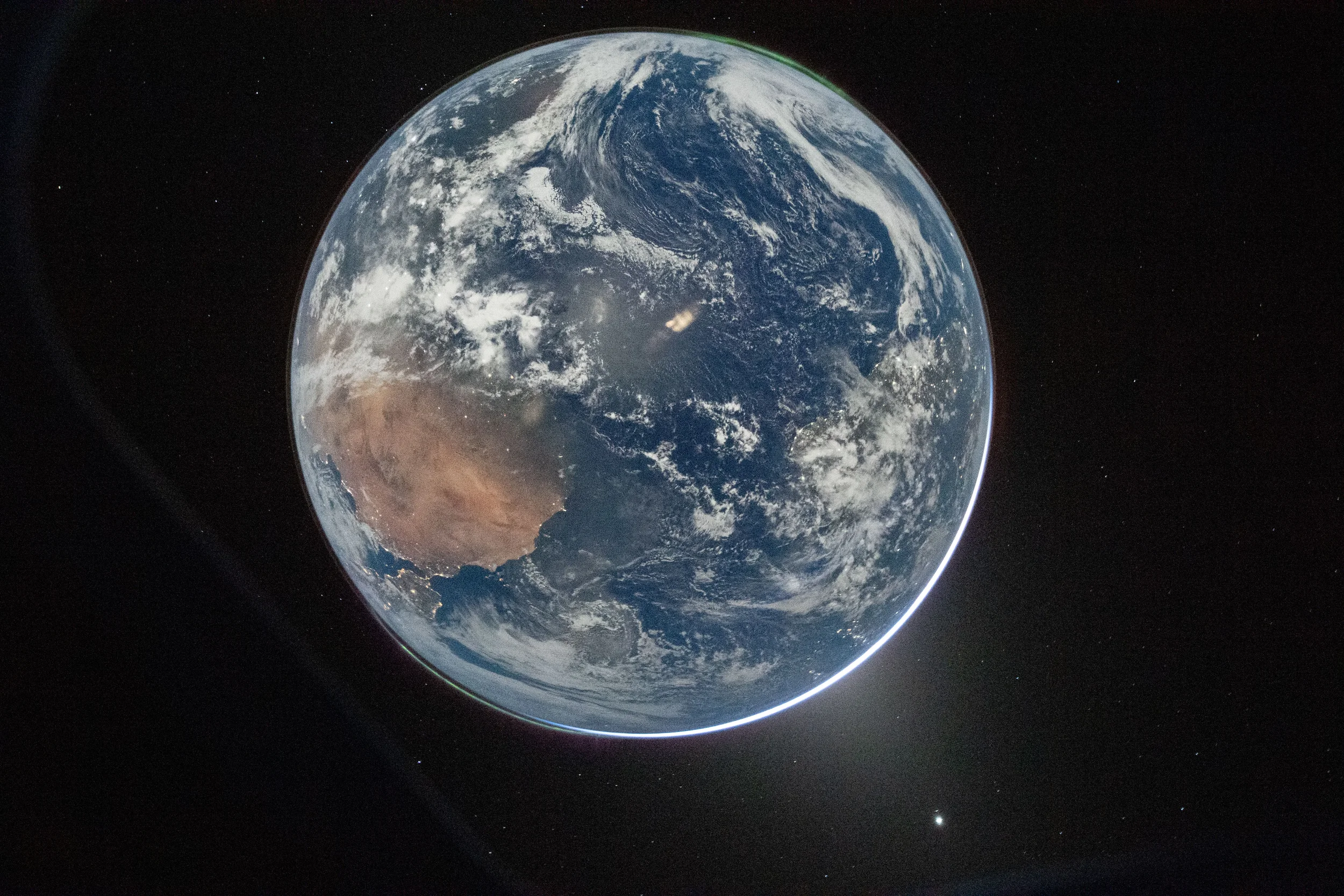
Perhaps recent views of the Earth from space will provide that jolt we need to see the truth. How about that picture from the Artemis II expedition, in which we see the Earth surrounded by that incredibly thin layer of atmosphere, along with those iconic photos from the 1968 Apollo mission…the ones known as Earthrise and the Blue Marble? The usual reaction to these photos is an overwhelming sense of our interconnectedness with each other and with the entire planet, and our dependence on each other, because that’s all there is. Otherwise, we are surrounded by just the vastness of space.
It’s being called the Overview Effect, being able to see that what we do in one place affects everything everywhere. It makes us realize that we need to deal compassionately and kindly with all living things, and as we learn in the Genesis creation story, we must preserve and cherish this place because we are all in this together on this planet, the only place we can call home. We can’t mess this up, y’all.
Perhaps reactions to pictures from the Artemis mission will help us see with new eyes and burning hearts…and leave us willing to make the changes needed for a renewal of all of life on the planet. Because resurrection is an ongoing process. And we have opportunities every day to do our part.
One of those opportunities can be found in a program we are featuring in the parish house this morning called Homegrown National Park. The idea is that if everyone planted a small pollinator garden in their backyard, combined we could create the largest national park in the country, as a series of connected micro-refuges for our wild neighbors. Biodiversity loss is one of the major threats to life on Earth right now, with bees and butterflies among the most threatened species. We can each do our part to help with that. Come check it out after church. We even have packets of seeds to hand out, along with other information to get you started.
Experiencing the risen Christ does not come at the end of a lesson on a road…or through a sermon. There is something about faith that is “made known” outside the normal ways of knowing. It is in the breaking of bread that the disciples finally “see.” Perhaps it is the vision of our Earth floating all alone in a vast expanse of space, or in working in the dirt with native plants for the benefit of the smallest creatures, that we finally see how we can participate in the ongoing resurrection of all Creation.
Lella Lowe